Page Tables
Page tables let the operating system control what memory addresses mean. They allow xv6 to multiplex the address spaces of different processes onto a single physical memory and to protect the memories of different processes. The level of indirection provided by page tables enables many neat tricks. xv6 uses page tables primarily to multiplex address spaces and to protect memory. It also uses a few simple page-table tricks: mapping the same memory (the kernel) in several address spaces, mapping the same memory more than once in one address space (each user page is also mapped into the kernel's physical view of memory), and guarding a user stack with an unmapped page. The rest of this chapter explains the page tables that the x86 hardware provides and how xv6 uses them. Compared to a real-world operating system, xv6's design is restrictive, but it illustrates the key ideas.
Paging hardware
As a reminder, x86 instructions (both user and kernel) manipulate virtual addresses. The machine's RAM, or physical memory, is indexed with physical addresses. The x86 page table hardware connects these two kinds of addresses by mapping each virtual address to a physical address.
On x86-64, address translation uses a multi-level page table. For the common 4 KiB page size, a canonical virtual address is split into a 12-bit page offset and four 9-bit indices (one per level): PML4, page-directory-pointer table (PDPT), page directory (PD), and page table (PT). Each index selects one entry out of 512 (2^9) entries in the corresponding level.
Each entry contains (among other bits) a physical page number (PPN) that points either to the next-level page-table page (for PML4/PDPT/PD entries) or to the final mapped physical page (for a PT entry), plus a set of flags that control access (present, writable, user, execute-disable, etc.).
To translate a virtual address, the hardware starts from the physical base address in cr3 (the PML4), uses the top-level index to fetch a PML4 entry, follows its PPN to the next table, and repeats for PDPT and PD. The final PT entry supplies the PPN of the target physical page. The hardware forms the physical address by concatenating that PPN with the unchanged 12-bit offset. Thus, paging gives the OS control over virtual-to-physical translations at 4 KiB granularity.
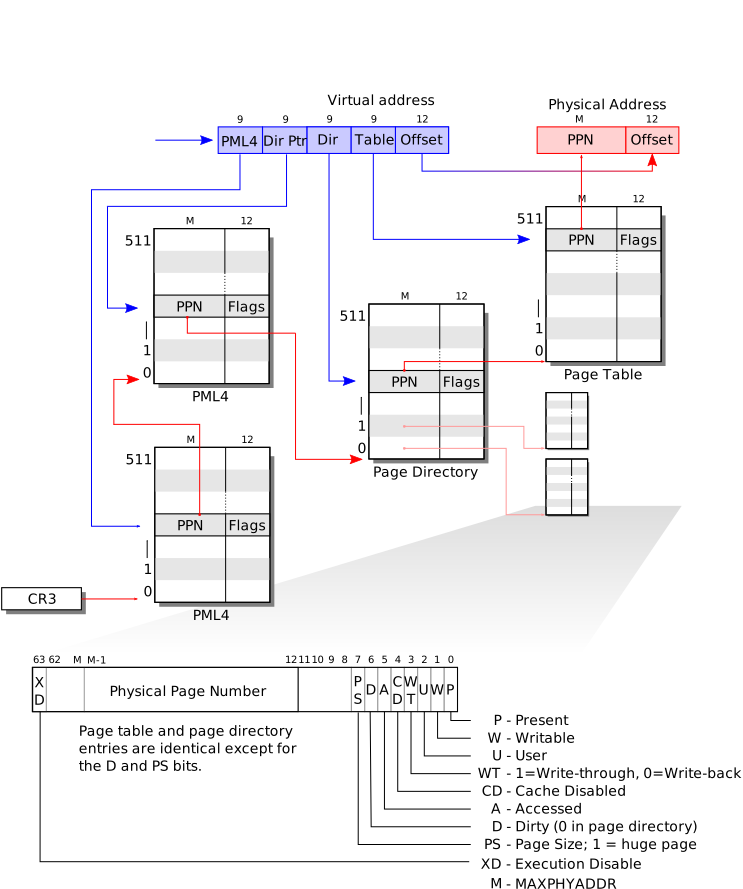
As shown in Figure, x86-64 performs translation by walking up to four page-table levels (for 4 KiB pages). The root is the PML4 page whose physical address is stored in cr3. A PML4 entry points to a PDPT page; a PDPT entry points to a page directory (PD) page; and a PD entry points to a page table (PT) page. Each of these pages is 4096 bytes and contains 512 64-bit entries.
The hardware uses the 9-bit indices from the virtual address to select an entry at each level (PML4 → PDPT → PD → PT). If any required entry is not present, the hardware raises a page-fault exception. This multi-level structure lets a page table omit entire lower-level pages when large ranges of virtual addresses are unmapped, saving memory.
Each entry contains flag bits that tell the paging hardware how the associated virtual address is allowed to be used. For example, the present bit controls whether a translation exists; the writable bit controls whether stores are permitted; the user bit controls whether code running in user mode may access the page; and the execute-disable (XD/NX) bit (if supported and enabled) can prevent instruction fetches from the page. The exact flag definitions used by xv6 live in the paging header (e.g., mmu.h/vm.h, depending on your code base).
A few notes about terms. Physical memory refers to storage cells in DRAM. A byte of physical memory has an address, called a physical address. Instructions use virtual addresses, which the paging hardware translates to physical addresses and then sends to the DRAM hardware to read or write storage. In this discussion, "virtual memory" refers to the abstraction provided by these translations and permissions; the hardware mechanism itself operates on virtual addresses.
Process address space
The page table created by entry has enough mappings to allow the kernel's C code to start running. However, main immediately changes to a new page table by calling kvmalloc (see vm.c), because the kernel has a more elaborate plan for describing process address spaces.
Each process has a separate page table, and xv6 tells the page table hardware to switch page tables when xv6 switches between processes. As shown in Figure, a process's user memory starts at virtual address zero and can grow up to 0x7FFFFFFFFFFF, allowing a process to address up to 128 terabytes of memory. The file memlayout.h declares the constants for xv6's memory layout and macros to convert virtual to physical addresses.
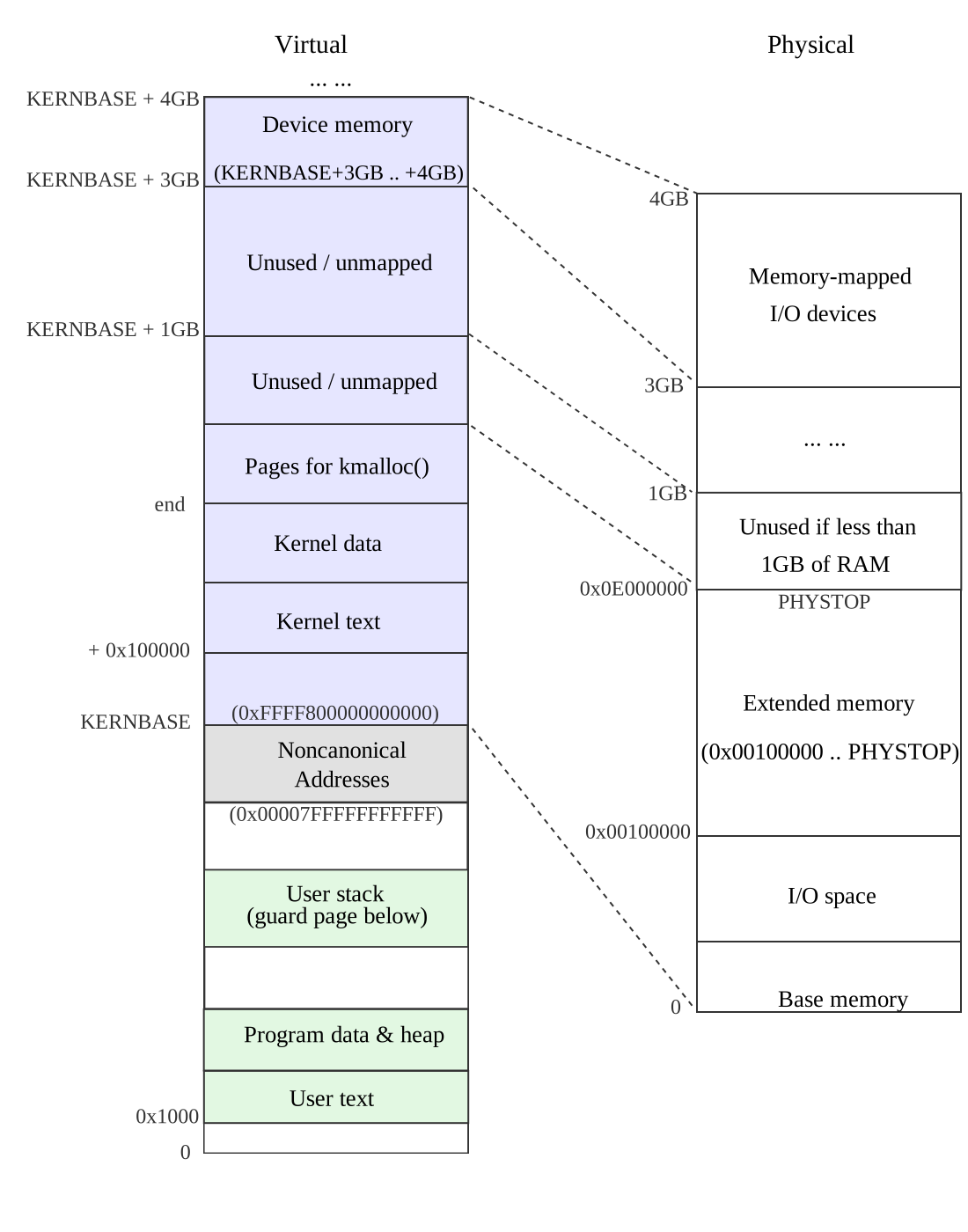
When a process asks xv6 for more memory, xv6 first finds free physical pages to provide the storage, and then adds PTEs to the process's page table that point to the new physical pages. xv6 sets the PTE_U, PTE_W, and PTE_P flags in these PTEs. Most processes do not use the entire user address space; xv6 leaves PTE_P clear in unused PTEs. Different processes' page tables translate user addresses to different pages of physical memory, so that each process has private user memory.
xv6 includes all mappings needed for the kernel to run in every process's page table; these mappings all appear above KERNBASE. It maps virtual addresses KERNBASE:KERNBASE+PHYSTOP to 0:PHYSTOP. One reason for this mapping is so that the kernel can use its own instructions and data. Another reason is that the kernel sometimes needs to be able to write a given page of physical memory, for example when creating page table pages; having every physical page appear at a predictable virtual address makes this convenient.
Some devices that use memory-mapped I/O appear at physical addresses starting at 0xFE000000, so xv6 page tables include a direct mapping for them.
xv6 does not set the PTE_U flag in the PTEs above KERNBASE, so only the kernel can use them.
Having every process's page table contain mappings for both user memory and the entire kernel is convenient when switching from user code to kernel code during system calls and interrupts: such switches do not require page table switches. For the most part the kernel does not have its own page table; it is almost always borrowing some process's page table.
To review, xv6 ensures that each process can use only its own memory. And, each process sees its memory as having contiguous virtual addresses starting at zero, while the process's physical memory can be non-contiguous. xv6 implements the first by setting the PTE_U bit only on PTEs of virtual addresses that refer to the process's own memory. It implements the second using the ability of page tables to translate successive virtual addresses to whatever physical pages happen to be allocated to the process.
Code: creating an address space
main calls kvmalloc to create and switch to a page table with the mappings above KERNBASE that are required for the kernel to run. Most of the work happens in setupkvm (see vm.c). It first allocates a page of memory to hold the page directory. Then it calls mappages to install the translations that the kernel needs, which are described in the kmap array in vm.c. The translations include the kernel's instructions and data, physical memory up to PHYSTOP, and memory ranges that are actually I/O devices. setupkvm does not install any mappings for the user memory; this will happen later.
mappages installs mappings into a page table for a range of virtual addresses to a corresponding range of physical addresses. It does this separately for each virtual address in the range, at page intervals. For each virtual address to be mapped, mappages calls walkpgdir to find the address of the PTE for that address. It then initializes the PTE to hold the relevant physical page number, the desired permissions (PTE_W and/or PTE_U), and PTE_P to mark the PTE as valid.
walkpgdir mimics the actions of the x86 paging hardware as it looks up the PTE for a virtual address. It uses the upper 10 bits of the virtual address to find the page directory entry. If the page directory entry isn't present, then the required page table page hasn't yet been allocated; if the alloc argument is set, walkpgdir allocates it and puts its physical address in the page directory. Finally it uses the next 10 bits of the virtual address to find the address of the PTE in the page table page.
Physical memory allocation
The kernel must allocate and free physical memory at run-time for page tables, process user memory, kernel stacks, and pipe buffers.
xv6 uses the physical memory between the end of the kernel and PHYSTOP for run-time allocation. It allocates and frees whole 4096-byte pages at a time. It keeps track of which pages are free by threading a linked list through the pages themselves. Allocation consists of removing a page from the linked list; freeing consists of adding the freed page to the list.
There is a bootstrap problem: all of physical memory must be mapped in order for the allocator to initialize the free list, but creating a page table with those mappings involves allocating page-table pages. xv6 solves this problem by using a separate page allocator during entry, which allocates memory just after the end of the kernel's data segment. This allocator does not support freeing and is limited by the 4 MB mapping in the entrypgdir, but that is sufficient to allocate the first kernel page table.
Code: physical memory allocator
The allocator's data structure is a free list of physical memory pages that are available for allocation. Each free page's list element is a struct run (see kalloc.c). Where does the allocator get the memory to hold that data structure? It stores each free page's run structure in the free page itself, since there's nothing else stored there. The free list is protected by a spin lock. The list and the lock are wrapped in a struct to make clear that the lock protects the fields in the struct. For now, ignore the lock and the calls to acquire and release; Chapter 5 will examine locking in detail.
The function main calls kinit1 and kinit2 to initialize the allocator (see kalloc.c). The reason for having two calls is that for much of main one cannot use locks or memory above 4 megabytes. The call to kinit1 sets up for lock-less allocation in the first 4 megabytes, and the call to kinit2 enables locking and arranges for more memory to be allocatable. Ideally main would determine how much physical memory is available, but this turns out to be difficult on the x86. Instead it assumes that the machine has 224 megabytes (PHYSTOP) of physical memory, and uses all the memory between the end of the kernel and PHYSTOP as the initial pool of free memory. kinit1 and kinit2 call freerange to add memory to the free list via per-page calls to kfree. A PTE can only refer to a physical address that is aligned on a 4096-byte boundary (is a multiple of 4096), so freerange uses PGROUNDUP to ensure that it frees only aligned physical addresses. The allocator starts with no memory; these calls to kfree give it some to manage.
The allocator refers to physical pages by their virtual addresses as mapped in high memory, not by their physical addresses, which is why kinit uses P2V(PHYSTOP) to translate PHYSTOP (a physical address) to a virtual address. The allocator sometimes treats addresses as integers in order to perform arithmetic on them (for example, traversing all pages in kinit), and sometimes uses addresses as pointers to read and write memory (for example, manipulating the run structure stored in each page); this dual use of addresses is the main reason that the allocator code is full of C type casts. The other reason is that freeing and allocation inherently change the type of the memory.
The function kfree begins by setting every byte in the memory being freed to the value 1. This will cause code that uses memory after freeing it (uses "dangling references") to read garbage instead of the old valid contents; hopefully that will cause such code to break faster. Then kfree casts v to a pointer to struct run, records the old start of the free list in r->next, and sets the free list equal to r. kalloc removes and returns the first element in the free list.
User part of an address space

Figure shows the layout of the user memory of an executing process in xv6. Each user process starts at address 0. The bottom of the address space contains the text for the user program, its data, and its stack. The heap is above the stack so that the heap can expand when the process calls sbrk. Note that the text, data, and stack sections are laid out contiguously in the process's address space but xv6 is free to use non-contiguous physical pages for those sections. For example, when xv6 expands a process's heap, it can use any free physical page for the new virtual page and then program the page table hardware to map the virtual page to the allocated physical page. This flexibility is a major advantage of using paging hardware.
The stack is a single page, and is shown with the initial contents as created by exec. Strings containing the command-line arguments, as well as an array of pointers to them, are at the very top of the stack. Just under that are values that allow a program to start at main as if the function call main(argc, argv) had just started. To guard a stack growing off the stack page, xv6 places a guard page right below the stack. The guard page is not mapped and so if the stack runs off the stack page, the hardware will generate an exception because it cannot translate the faulting address. A real-world operating system might allocate more space for the stack so that it can grow beyond one page.
Code: sbrk
sbrk is the system call for a process to shrink or grow its memory. The system call is implemented by the function growproc (see proc.c). If n is positive, growproc allocates one or more physical pages and maps them at the top of the process's address space. If n is negative, growproc unmaps one or more pages from the process's address space and frees the corresponding physical pages.
To make these changes, xv6 modifies the process's page table. The process's page table is stored in memory, and so the kernel can update the table with ordinary assignment statements, which is what allocuvm and deallocuvm do. The x86 hardware caches page table entries in a Translation Look-aside Buffer (TLB), and when xv6 changes the page tables, it must invalidate the cached entries. If it didn't invalidate the cached entries, then at some point later the TLB might use an old mapping, pointing to a physical page that in the mean time has been allocated to another process, and as a result, a process might be able to scribble on some other process's memory. Xv6 invalidates stale cached entries by reloading cr3, the register that holds the address of the current page table.
Code: exec
exec is the system call that creates the user part of an address space. It initializes the user part of an address space from a file stored in the file system. exec (see exec.c) opens the named binary path using namei, which is explained in Chapter 7. Then, it reads the ELF header. Xv6 applications are described in the widely used ELF format, defined in elf.h. An ELF binary consists of an ELF header, struct elfhdr, followed by a sequence of program section headers, struct proghdr. Each proghdr describes a section of the application that must be loaded into memory; xv6 programs have only one program section header, but other systems might have separate sections for instructions and data.
The first step is a quick check that the file probably contains an ELF binary. An ELF binary starts with the four-byte magic number 0x7F, E, L, F, or ELF_MAGIC. If the ELF header has the right magic number, exec assumes that the binary is well-formed.
exec allocates a new page table with no user mappings with setupkvm, allocates memory for each ELF segment with allocuvm, and loads each segment into memory with loaduvm. allocuvm checks that the virtual addresses requested are below KERNBASE. loaduvm uses walkpgdir to find the physical address of the allocated memory at which to write each page of the ELF segment, and readi to read from the file.
The program section header for /init, the first user program created with exec, looks like this:
# objdump -p _init

_init:	file format elf64-x86-64

Program Header:
    LOAD off    0x0000000000000080 vaddr 0x0000000000001000 paddr 0x0000000000001000 align 2**4
         filesz 0x0000000000000f31 memsz 0x0000000000000f58 flags rwx
The program section header's filesz may be less than the memsz, indicating that the gap between them should be filled with zeroes (for C global variables) rather than read from the file. For /init, filesz is 3,889 bytes and memsz is 3,928 bytes, and thus allocuvm allocates enough physical memory to hold 3,928 bytes, but reads only 3,889 bytes from the file /init.
Now exec allocates and initializes the user stack. It allocates just one stack page. exec copies the argument strings to the top of the stack one at a time, recording the pointers to them in ustack. It places a null pointer at the end of what will be the argv list passed to main. The first three entries in ustack are the fake return PC, argc, and argv pointer.
exec places an inaccessible page just below the stack page, so that programs that try to use more than one page will fault. This inaccessible page also allows exec to deal with arguments that are too large; in that situation, the copyout function that exec uses to copy arguments to the stack will notice that the destination page is not accessible, and will return -1.
During the preparation of the new memory image, if exec detects an error like an invalid program segment, it jumps to the label bad, frees the new image, and returns -1. exec must wait to free the old image until it is sure that the system call will succeed: if the old image is gone, the system call cannot return -1 to it. The only error cases in exec happen during the creation of the image. Once the image is complete, exec can install the new image and free the old one. Finally, exec returns 0.
exec loads bytes from the ELF file into memory at addresses specified by the ELF file. Users or processes can place whatever addresses they want into an ELF file. Thus exec is risky, because the addresses in the ELF file may refer to the kernel, accidentally or on purpose. The consequences for an unwary kernel could range from a crash to a malicious subversion of the kernel's isolation mechanisms (that is, a security exploit). xv6 performs a number of checks to avoid these risks. To understand the importance of these checks, consider what could happen if xv6 didn't check if(ph.vaddr + ph.memsz < ph.vaddr). This is a check for whether the sum overflows a 32-bit integer. The danger is that a user could construct an ELF binary with a ph.vaddr that points into the kernel, and ph.memsz large enough that the sum overflows to 0x1000. Since the sum is small, it would pass the check if(newsz >= KERNBASE) in allocuvm. The subsequent call to loaduvm passes ph.vaddr by itself, without adding ph.memsz and without checking ph.vaddr against KERNBASE, and would thus copy data from the ELF binary into the kernel. This could be exploited by a user program to run arbitrary user code with kernel privileges. As this example illustrates, argument checking must be done with great care. It is easy for a kernel developer to omit a crucial check, and real-world kernels have a long history of missing checks whose absence can be exploited by user programs to obtain kernel privileges. It is likely that xv6 doesn't do a complete job of validating user-level data supplied to the kernel, which a malicious user program might be able to exploit to circumvent xv6's isolation.
Real world
Like most operating systems, xv6 uses the paging hardware for memory protection and mapping. Most operating systems make far more sophisticated use of paging than xv6; for example, xv6 lacks demand paging from disk, copy-on-write fork, shared memory, lazily-allocated pages, and automatically extending stacks.
The x86 supports address translation using segmentation, but xv6 uses segments only for the common trick of implementing per-CPU variables such as proc that are at a fixed address but have different values on different CPUs (see seginit). Implementations of per-CPU (or per-thread) storage on non-segment architectures would dedicate a register to holding a pointer to the per-CPU data area, but the x86 has so few general registers that the extra effort required to use segmentation is worthwhile.
Xv6 maps the kernel in the address space of each user process but sets it up so that the kernel part of the address space is inaccessible when the processor is in user mode. This setup is convenient because after a process switches from user space to kernel space, the kernel can easily access user memory by reading memory locations directly. It is probably better for security, however, to have a separate page table for the kernel and switch to that page table when entering the kernel from user mode, so that the kernel and user processes are more separated from each other. This design, for example, would help mitigate side-channels that are exposed by the Meltdown vulnerability and that allow a user process to read arbitrary kernel memory.
On machines with lots of memory it might make sense to use the x86's 4-megabyte "super pages." Small pages make sense when physical memory is small, to allow allocation and page-out to disk with fine granularity. For example, if a program uses only 8 kilobytes of memory, giving it a 4 megabytes physical page is wasteful. Larger pages make sense on machines with lots of RAM, and may reduce overhead for page-table manipulation.
Xv6 mainly uses 1GB large pages when setting up the kernel page table. In kvmalloc(), it installs entries in the page directory pointer table (PDPT) to create 1GB mappings. In x86-64, each paging structure (PML4, PDPT, PD, and PT) contains 512 entries.
To create a 1GB mapping, xv6 sets the PS (Page Size) bit in a PDPT entry. When the PS bit is set in a PDPT entry in long mode, that entry maps a 1GB region directly to physical memory. The hardware page-walk therefore terminates at the PDPT level and does not access a page directory or page table for addresses within that region.
Using 1GB large pages allows xv6 to map large contiguous regions of physical memory, such as the kernel's direct-mapped region, with a single paging-structure entry, which simplifies the initial kernel memory layout and reduces page-table overhead.
Xv6 should determine the actual RAM configuration, instead of assuming 224 MB. On the x86, there are at least three common algorithms: the first is to probe the physical address space looking for regions that behave like memory, preserving the values written to them; the second is to read the number of kilobytes of memory out of a known 16-bit location in the PC's non-volatile RAM; and the third is to look in BIOS memory for a memory layout table left as part of the multiprocessor tables. Reading the memory layout table is complicated.
Memory allocation was a hot topic a long time ago, the basic problems being efficient use of limited memory and preparing for unknown future requests; see Knuth. Today people care more about speed than space-efficiency. In addition, a more elaborate kernel would likely allocate many different sizes of small blocks, rather than (as in xv6) just 4096-byte blocks; a real kernel allocator would need to handle small allocations as well as large ones.
Exercises
- Look at real operating systems to see how they size memory.
- If xv6 had not used super pages, what would be the right declaration for
entrypgdir? - Write a user program that grows its address space with 1 byte by calling
sbrk(1). Run the program and investigate the page table for the program before the call tosbrkand after the call tosbrk. How much space has the kernel allocated? What does theptefor the new memory contain? - Modify xv6 so that the pages for the kernel are shared among processes, which reduces memory consumption.
- Modify xv6 so that when a user program dereferences a null pointer, it will receive a fault. That is, modify xv6 so that virtual address 0 isn't mapped for user programs.
- Unix implementations of
exectraditionally include special handling for shell scripts. If the file to execute begins with the text#!, then the first line is taken to be a program to run to interpret the file. For example, ifexecis called to runmyprog arg1andmyprog's first line is#!/interp, thenexecruns/interpwith command line/interp myprog arg1. Implement support for this convention in xv6. - Delete the check
if(ph.vaddr + ph.memsz < ph.vaddr)inexec.c, and construct a user program that exploits that the check is missing. - Change xv6 so that user processes run with only a minimal part of the kernel mapped and so that the kernel runs with its own page table that doesn't include the user process.
- How would you improve xv6's memory layout if xv6 were running on a 64-bit processor?