Scheduling
Any operating system is likely to run with more processes than the computer has processors, so a plan is needed to time-share the processors among the processes. Ideally the sharing would be transparent to user processes. A common approach is to provide each process with the illusion that it has its own virtual processor by multiplexing the processes onto the hardware processors. This chapter explains how xv6 achieves this multiplexing.
Multiplexing
Xv6 multiplexes by switching each processor from one process to another in two
situations. First, xv6's sleep and wakeup mechanism switches when a process
waits for device or pipe I/O to complete, or waits for a child to exit, or
waits in the sleep system call. Second, xv6 periodically forces a switch when
a process is executing user instructions. This multiplexing creates the
illusion that each process has its own CPU, just as xv6 uses the memory
allocator and hardware page tables to create the illusion that each process has
its own memory.
Implementing multiplexing poses a few challenges. First, how to switch from one process to another? Although the idea of context switching is simple, the implementation is some of the most opaque code in xv6. Second, how to switch transparently to user processes? Xv6 uses the standard technique of driving context switches with timer interrupts. Third, many CPUs may be switching among processes concurrently, and a locking plan is necessary to avoid races. Fourth, a process's memory and other resources must be freed when the process exits, but it cannot do all of this itself because (for example) it can't free its own kernel stack while still using it. Finally, each core of a multi-core machine must remember which process it is executing so that system calls affect the correct process's kernel state. Xv6 tries to solve these problems as simply as possible, but nevertheless the resulting code is tricky.
xv6 must provide ways for processes to coordinate among themselves. For example, a parent process may need to wait for one of its children to exit, or a process reading a pipe may need to wait for some other process to write the pipe. Rather than make the waiting process waste CPU by repeatedly checking whether the desired event has happened, xv6 allows a process to give up the CPU and sleep waiting for an event, and allows another process to wake the first process up. Care is needed to avoid races that result in the loss of event notifications. As an example of these problems and their solution, this chapter examines the implementation of pipes.
Code: Context switching
switch outlines the steps involved
in switching from one user process to another: a user-kernel transition (system
call or interrupt) to the old process's kernel thread, a context switch to the
current CPU's scheduler thread, a context switch to a new process's kernel
thread, and a trap return to the user-level process. The xv6 scheduler has its
own thread (saved registers and stack) because it is sometimes not safe for it
execute on any process's kernel stack; we'll see an example in exit. In this
section we'll examine the mechanics of switching between a kernel thread and a
scheduler thread.
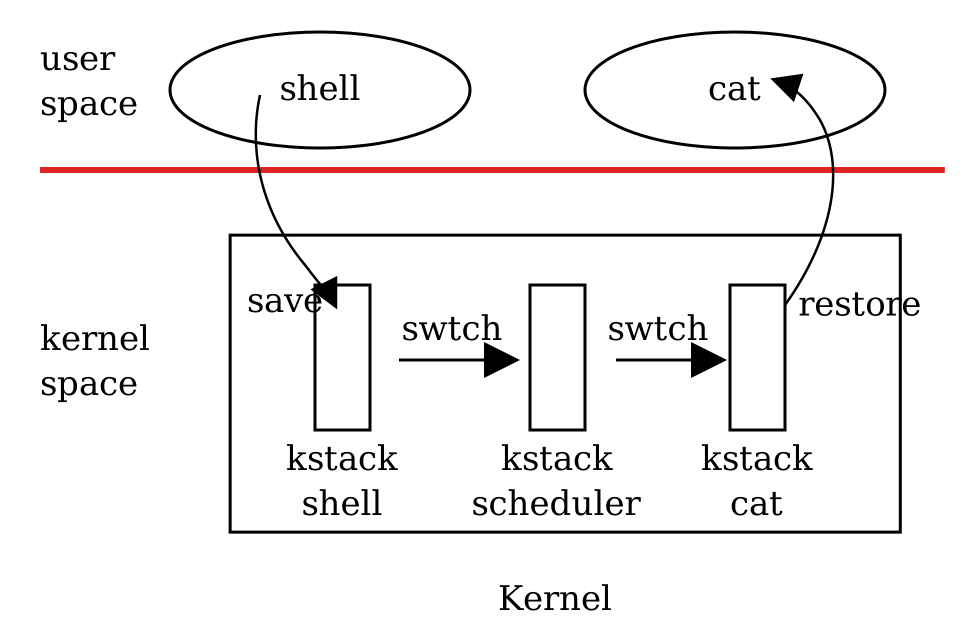
Switching from one thread to another involves saving the old thread's CPU
registers, and restoring the previously-saved registers of the new thread; the
fact that rsp and rip are saved and restored means that the CPU will switch
stacks and switch what code it is executing.
The function swtch performs the saves and restores for a thread switch.
swtch doesn't directly know about threads; it just saves and restores register
sets, called contexts. When it is time for a process to give up the CPU, the
process's kernel thread calls swtch to save its own context and return to the
scheduler context. Each context is represented by a struct context*, a pointer
to a structure stored on the kernel stack involved. swtch takes two
arguments: struct context **old and struct context *new. It pushes the
current registers onto the stack and saves the stack pointer in *old. Then
swtch copies new to rsp, pops previously saved registers, and returns.
Let's follow a user process through swtch into the scheduler. We saw in
Chapter 4, Interrupts, and Drivers that one possibility at the end of each
interrupt is that trap calls yield. yield in turn calls sched, which
calls swtch to save the current context in proc->context and switch to the
scheduler context previously saved in cpu->scheduler.
swtch starts by copying its arguments from the stack to the caller-saved
registers rax and rdx; swtch must do this before it changes the stack
pointer and can no longer access the arguments via rsp. Then swtch pushes
the register state, creating a context structure on the current stack. Only the
callee-saved registers need to be saved; the convention on the x86 is that
these are rbp, rbx, rsi, rdi, and rsp. swtch pushes the first four
explicitly; it saves the last implicitly as the struct context* written to
*old. There is one more important register: the program counter rip. It has
already been saved on the stack by the call instruction that invoked swtch.
Having saved the old context, swtch is ready to restore the new one. It moves
the pointer to the new context into the stack pointer. The new stack has the
same form as the old one that swtch just left—the new stack was the old one
in a previous call to swtch—so swtch can invert the sequence to restore the
new context. It pops the values for rdi, rsi, rbx, and rbp and then
returns. Because swtch has changed the stack pointer, the values restored and
the instruction address returned to are the ones from the new context.
In our example, sched called swtch to switch to cpu->scheduler, the
per-CPU scheduler context. That context had been saved by scheduler's call to
swtch. When the swtch we have been tracing returns, it returns not to
sched but to scheduler, and its stack pointer points at the current CPU's
scheduler stack.
Code: Scheduling
The last section looked at the low-level details of swtch; now let's take
swtch as a given and examine switching from a process through the scheduler
to another process. A process that wants to give up the CPU must acquire the
process table lock ptable.lock, release any other locks it is holding, update
its own state (proc->state), and then call sched. yield follows this
convention, as do sleep and exit, which we will examine later. sched
double-checks those conditions and then an implication of those conditions:
since a lock is held, the CPU should be running with interrupts disabled.
Finally, sched calls swtch to save the current context in proc->context
and switch to the scheduler context in cpu->scheduler. swtch returns on the
scheduler's stack as though scheduler's swtch had returned. The scheduler
continues the for loop, finds a process to run, switches to it, and the cycle
repeats.
We just saw that xv6 holds ptable.lock across calls to swtch: the caller of
swtch must already hold the lock, and control of the lock passes to the
switched-to code. This convention is unusual with locks; usually the thread
that acquires a lock is also responsible for releasing the lock, which makes it
easier to reason about correctness. For context switching it is necessary to
break this convention because ptable.lock protects invariants on the
process's state and context fields that are not true while executing in
swtch. One example of a problem that could arise if ptable.lock were not
held during swtch: a different CPU might decide to run the process after
yield had set its state to RUNNABLE, but before swtch caused it to stop
using its own kernel stack. The result would be two CPUs running on the same
stack, which cannot be right.
A kernel thread always gives up its processor in sched and always switches to
the same location in the scheduler, which (almost) always switches to some
kernel thread that previously called sched. Thus, if one were to print out
the line numbers where xv6 switches threads, one would observe the following
simple pattern: the swtch in sched, the swtch in scheduler, and so on. The
procedures in which this stylized switching between two threads happens are
sometimes referred to as coroutines; in this example, sched and
scheduler are co-routines of each other.
There is one case when the scheduler's call to swtch does not end up in
sched. We saw this case in Chapter 3: when a new process is first
scheduled, it begins at forkret. forkret exists to release the
ptable.lock; otherwise, the new process could start at trapret.
scheduler runs a simple loop: find a process to run, run it until it yields,
repeat. scheduler holds ptable.lock for most of its actions, but releases
the lock (and explicitly enables interrupts) once in each iteration of its
outer loop. This is important for the special case in which this CPU is idle
(can find no RUNNABLE process). If an idling scheduler looped with the lock
continuously held, no other CPU that was running a process could ever perform a
context switch or any process-related system call, and in particular could
never mark a process as RUNNABLE so as to break the idling CPU out of its
scheduling loop. The reason to enable interrupts periodically on an idling CPU
is that there might be no RUNNABLE process because processes (e.g., the shell)
are waiting for I/O; if the scheduler left interrupts disabled all the time,
the I/O would never arrive.
The scheduler loops over the process table looking for a runnable process, one
that has p->state == RUNNABLE. Once it finds a process, it sets the per-CPU
current process variable proc, switches to the process's page table with
switchuvm, marks the process as RUNNING, and then calls swtch to start
running it.
One way to think about the structure of the scheduling code is that it arranges
to enforce a set of invariants about each process, and holds ptable.lock
whenever those invariants are not true. One invariant is that if a process is
RUNNING, a timer interrupt's yield must be able to switch away from the
process; this means that the CPU registers must hold the process's register
values (i.e. they aren't actually in a context), cr3 must refer to the
process's pagetable, rsp must refer to the process's kernel stack so that
swtch can push registers correctly, and proc must refer to the process's
proc[] slot. Another invariant is that if a process is RUNNABLE, an idle
CPU's scheduler must be able to run it; this means that p->context must hold
the process's kernel thread variables, that no CPU is executing on the
process's kernel stack, that no CPU's cr3 refers to the process's page table,
and that no CPU's proc refers to the process.
Maintaining the above invariants is the reason why xv6 acquires ptable.lock
in one thread (often in yield) and releases the lock in a different thread
(the scheduler thread or another next kernel thread). Once the code has started
to modify a running process's state to make it RUNNABLE, it must hold the lock
until it has finished restoring the invariants: the earliest correct release
point is after scheduler stops using the process's page table and clears
proc. Similarly, once scheduler starts to convert a runnable process to
RUNNING, the lock cannot be released until the kernel thread is completely
running (after the swtch, e.g. in yield).
ptable.lock protects other things as well: allocation of process IDs and free
process table slots, the interplay between exit and wait, the machinery to
avoid lost wakeups (see next section), and probably other things too. It might
be worth thinking about whether the different functions of ptable.lock could
be split up, certainly for clarity and perhaps for performance.
Code: mycpu and myproc
xv6 maintains a struct cpu for each processor, which records the process
currently running on the processor (if any), the processor's unique hardware
identifier (apicid), and some other information. The function mycpu returns
the current processor's struct cpu. mycpu does this by reading the
processor identifier from the local APIC hardware and looking through the array
of struct cpu for an entry with that identifier. The return value of mycpu
is fragile: if the timer were to interrupt and cause the thread to be moved to
a different processor, the return value would no longer be correct. To avoid
this problem, xv6 requires that callers of mycpu disable interrupts, and only
enable them after they finish using the returned struct cpu.
The function myproc returns the struct proc pointer for the process that is
running on the current processor. myproc disables interrupts, invokes
mycpu, fetches the current process pointer (c->proc) out of the
struct cpu, and then enables interrupts. If there is no process running,
because the caller is executing in scheduler, myproc returns zero. The
return value of myproc is safe to use even if interrupts are enabled: if a
timer interrupt moves the calling process to a different processor, its
struct proc pointer will stay the same.
Sleep and wakeup
Scheduling and locks help conceal the existence of one process from another, but so far we have no abstractions that help processes intentionally interact. Sleep and wakeup fill that void, allowing one process to sleep waiting for an event and another process to wake it up once the event has happened. Sleep and wakeup are often called sequence coordination or conditional synchronization mechanisms, and there are many other similar mechanisms in the operating systems literature.
To illustrate what we mean, let's consider a simple producer/consumer queue. This queue is similar to the one that feeds commands from processes to the IDE driver (see Chapter 4: Traps, Interrupts, and Drivers), but abstracts away all IDE-specific code. The queue allows one process to send a nonzero pointer to another process. If there were only one sender and one receiver, and they executed on different CPUs, and the compiler didn't optimize too agressively, this implementation would be correct:
  100  struct q {
  101    void *ptr;
  102  };
  103
  104  void*
  105  send(struct q *q, void *p)
  106  {
  107    while(q->ptr != 0)
  108      ;
  109    q->ptr = p;
  110  }
  111
  112  void*
  113  recv(struct q *q)
  114  {
  115    void *p;
  116
  117    while((p = q->ptr) == 0)
  118      ;
  119    q->ptr = 0;
  120    return p;
  121  }
send loops until the queue is empty (ptr == 0) and then puts the pointer
p in the queue. recv loops until the queue is non-empty and takes the
pointer out. When run in different processes, send and recv both modify
q->ptr, but send only writes the pointer when it is zero and recv only
writes the pointer when it is nonzero, so no updates are lost.
The implementation above is expensive. If the sender sends rarely, the
receiver will spend most of its time spinning in the while loop hoping for a
pointer. The receiver's CPU could find more productive work than busy
waiting by repeatedly polling q->ptr. Avoiding busy waiting requires a way
for the receiver to yield the CPU and resume only when send delivers a
pointer.
Let's imagine a pair of calls, sleep and wakeup, that work as follows.
sleep(chan) sleeps on the arbitrary value chan, called the wait channel.
sleep puts the calling process to sleep, releasing the CPU for other work.
wakeup(chan) wakes all processes sleeping on chan (if any), causing their
sleep calls to return. If no processes are waiting on chan, wakeup does
nothing. We can change the queue implementation to use sleep and wakeup:
  201  void*
  202  send(struct q *q, void *p)
  203  {
  204    while(q->ptr != 0)
  205      ;
  206    q->ptr = p;
  207    wakeup(q);  /* wake recv */
  208  }
  209
  210  void*
  211  recv(struct q *q)
  212  {
  213    void *p;
  214
  215    while((p = q->ptr) == 0)
  216      sleep(q);
  217    q->ptr = 0;
  218    return p;
  219  }
recv now gives up the CPU instead of spinning, which is nice. However, it
turns out not to be straightforward to design sleep and wakeup with this
interface without suffering from what is known as the ``lost wake-up'' problem
(see deadlock). Suppose that
recv finds that q->ptr == 0 on line 215. While recv is between lines 215
and 216, send runs on another CPU: it changes q->ptr to be nonzero and
calls wakeup, which finds no processes sleeping and thus does nothing. Now
recv continues executing at line 216: it calls sleep and goes to sleep. This
causes a problem: recv is asleep waiting for a pointer that has already
arrived. The next send will wait for recv to consume the pointer in the
queue, at which point the system will be deadlocked.
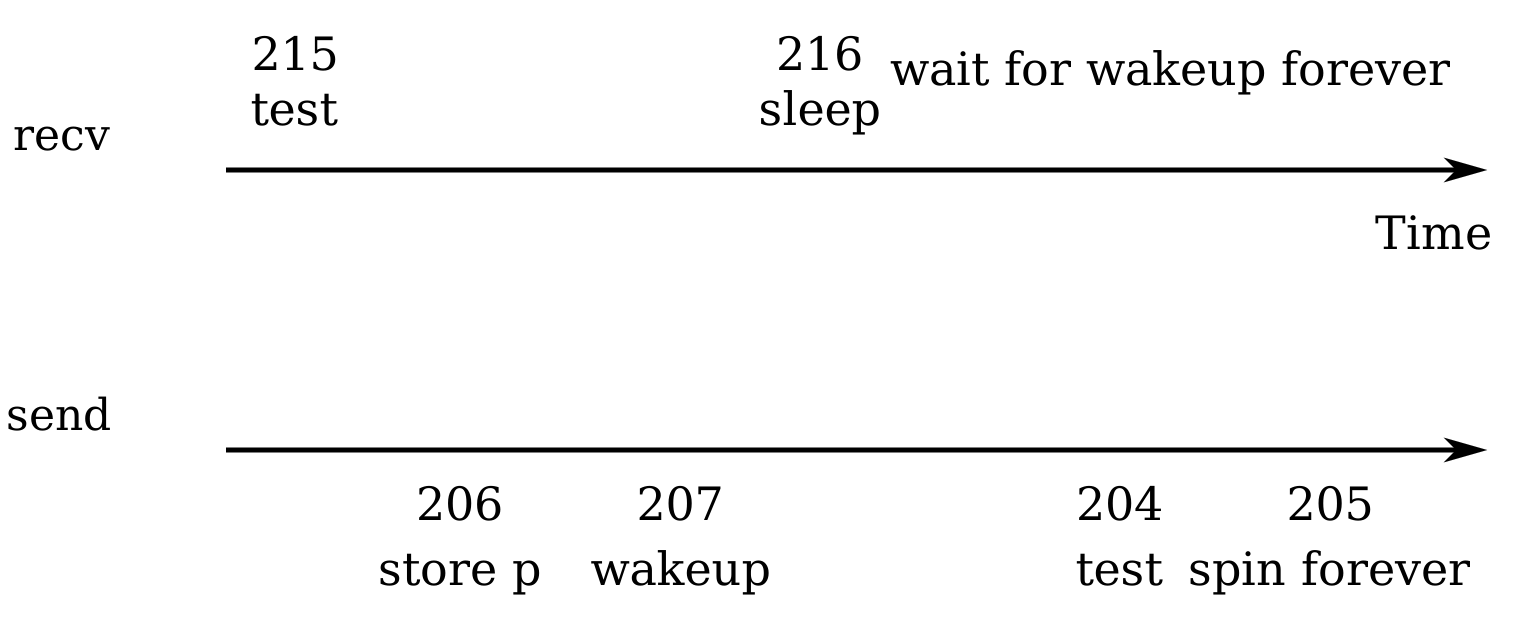
The root of this problem is that the invariant that recv only sleeps when
q->ptr == 0 is violated by send running at just the wrong moment. One
incorrect way of protecting the invariant would be to modify the code for
recv as follows:
  300  struct q {
  301    struct spinlock lock;
  302    void *ptr;
  303  };
  304
  305  void*
  306  send(struct q *q, void *p)
  307  {
  308    acquire(&q->lock);
  309    while(q->ptr != 0)
  310      ;
  311    q->ptr = p;
  312    wakeup(q);
  313    release(&q->lock);
  314  }
  315
  316  void*
  317  recv(struct q *q)
  318  {
  319    void *p;
  320
  321    acquire(&q->lock);
  322    while((p = q->ptr) == 0)
  323      sleep(q);
  324    q->ptr = 0;
  325    release(&q->lock);
  326    return p;
  327  }
One might hope that this version of recv would avoid the lost wakeup because
the lock prevents send from executing between lines 322 and 323. It does
that, but it also deadlocks: recv holds the lock while it sleeps, so the
sender will block forever waiting for the lock.
We'll fix the preceding scheme by changing sleep's interface: the caller must
pass the lock to sleep so it can release the lock after the calling process is
marked as asleep and waiting on the sleep channel. The lock will force a
concurrent send to wait until the receiver has finished putting itself to
sleep, so that the wakeup will find the sleeping receiver and wake it up.
Once the receiver is awake again sleep reacquires the lock before returning.
Our new correct scheme is useable as follows:
  400  struct q {
  401    struct spinlock lock;
  402    void *ptr;
  403  };
  404
  405  void*
  406  send(struct q *q, void *p)
  407  {
  408    acquire(&q->lock);
  409    while(q->ptr != 0)
  410      ;
  411    q->ptr = p;
  412    wakeup(q);
  413    release(&q->lock);
  414  }
  415
  416  void*
  417  recv(struct q *q)
  418  {
  419    void *p;
  420
  421    acquire(&q->lock);
  422    while((p = q->ptr) == 0)
  423      sleep(q, &q->lock);
  424    q->ptr = 0;
  425    release(&q->lock);
  426    return p;
  427  }
The fact that recv holds q->lock prevents send from trying to wake it up
between recv's check of q->ptr and its call to sleep. We need sleep to
atomically release q->lock and put the receiving process to sleep.
A complete sender/receiver implementation would also sleep in send when
waiting for a receiver to consume the value from a previous send.
Code: Sleep and wakeup
Let's look at the implementation of sleep and wakeup in proc.c. The basic
idea is to have sleep mark the current process as SLEEPING and then call
sched to release the processor; wakeup looks for a process sleeping on the
given wait channel and marks it as RUNNABLE. Callers of sleep and wakeup
can use any mutually convenient number as the channel. Xv6 often uses the
address of a kernel data structure involved in the waiting.
sleep begins with a few sanity checks: there must be a current process and
sleep must have been passed a lock. Then sleep acquires ptable.lock. Now
the process going to sleep holds both ptable.lock and lk. Holding lk was
necessary in the caller (in the example, recv): it ensured that no other
process (in the example, one running send) could start a call to
wakeup(chan). Now that sleep holds ptable.lock, it is safe to release
lk: some other process may start a call to wakeup(chan), but wakeup will
not run until it can acquire ptable.lock, so it must wait until sleep has
finished putting the process to sleep, keeping the wakeup from missing the
sleep.
There is a minor complication: if lk is equal to &ptable.lock, then sleep
would deadlock trying to acquire it as &ptable.lock and then release it as
lk. In this case, sleep considers the acquire and release to cancel each
other out and skips them entirely. For example, wait calls sleep with
&ptable.lock.
Now that sleep holds ptable.lock and no others, it can put the process to
sleep by recording the sleep channel, changing the process state, and calling
sched.
At some point later, a process will call wakeup(chan). wakeup acquires
ptable.lock and calls wakeup1, which does the real work. It is important
that wakeup hold the ptable.lock both because it is manipulating process
states and because, as we just saw, ptable.lock makes sure that sleep and
wakeup do not miss each other. wakeup1 is a separate function because
sometimes the scheduler needs to execute a wakeup when it already holds the
ptable.lock; we will see an example of this later. wakeup1 loops over the
process table. When it finds a process in state SLEEPING with a matching
chan, it changes that process's state to RUNNABLE. The next time the
scheduler runs, it will see that the process is ready to be run.
xv6 code always calls wakeup while holding the lock that guards the sleep
condition; in the example above that lock is q->lock. Strictly speaking it is
sufficient if wakeup always follows the acquire (that is, one could call
wakeup after the release). Why do the locking rules for sleep and wakeup
ensure a sleeping process won't miss a wakeup it needs? The sleeping process
holds either the lock on the condition or the ptable.lock or both from a
point before it checks the condition to a point after it is marked as sleeping.
If a concurrent thread causes the condition to be true, that thread must either
hold the lock on the condition before the sleeping thread acquired it, or after
the sleeping thread released it in sleep. If before, the sleeping thread must
have seen the new condition value, and decided to sleep anyway, so it doesn't
matter if it misses the wakeup. If after, then the earliest the waker could
acquire the lock on the condition is after sleep acquires ptable.lock, so
that wakeup's acquisition of ptable.lock must wait until sleep has
completely finished putting the sleeper to sleep. Then wakeup will see the
sleeping process and wake it up (unless something else wakes it up first).
It is sometimes the case that multiple processes are sleeping on the same
channel; for example, more than one process reading from a pipe. A single call
to wakeup will wake them all up. One of them will run first and acquire the
lock that sleep was called with, and (in the case of pipes) read whatever data
is waiting in the pipe. The other processes will find that, despite being woken
up, there is no data to be read. From their point of view the wakeup was
``spurious,'' and they must sleep again. For this reason sleep is always called
inside a loop that checks the condition.
No harm is done if two uses of sleep/wakeup accidentally choose the same channel: they will see spurious wakeups, but looping as described above will tolerate this problem. Much of the charm of sleep/wakeup is that it is both lightweight (no need to create special data structures to act as sleep channels) and provides a layer of indirection (callers need not know which specific process they are interacting with).
Code: Pipes
The simple queue we used earlier in this chapter was a toy, but xv6 contains
two real queues that use sleep and wakeup to synchronize readers and
writers. One is in the IDE driver: a process adds a disk request to a queue and
then calls sleep. The IDE interrupt handler uses wakeup to alert the process
that its request has completed.
A more complex example is the implementation of pipes. We saw the interface for
pipes in Chapter 1: bytes written to one end of a pipe
are copied in an in-kernel buffer and then can be read out of the other end of
the pipe. Future chapters will examine the file descriptor support surrounding
pipes, but let's look now at the implementations of pipewrite and piperead.
Each pipe is represented by a struct pipe, which contains a lock and a
data buffer. The fields nread and nwrite count the number of bytes read
from and written to the buffer. The buffer wraps around: the next byte written
after buf[PIPESIZE-1] is buf[0]. The counts do not wrap. This convention
lets the implementation distinguish a full buffer (nwrite == nread+PIPESIZE)
from an empty buffer (nwrite == nread), but it means that indexing into the
buffer must use buf[nread % PIPESIZE] instead of just buf[nread] (and
similarly for nwrite). Let's suppose that calls to piperead and pipewrite
happen simultaneously on two different CPUs.
pipewrite begins by acquiring the pipe's lock, which protects the counts, the
data, and their associated invariants. piperead then tries to acquire the
lock too, but cannot. It spins in acquire waiting for the lock. While
piperead waits, pipewrite loops over the bytes being written—addr[0],
addr[1], ..., addr[n-1]—adding each to the pipe in turn. During this loop,
it could happen that the buffer fills. In this case, pipewrite calls wakeup
to alert any sleeping readers to the fact that there is data waiting in the
buffer and then sleeps on &p->nwrite to wait for a reader to take some bytes
out of the buffer. sleep releases p->lock as part of putting pipewrite's
process to sleep.
Now that p->lock is available, piperead manages to acquire it and enters its
critical section: it finds that p->nread != p->nwrite (pipewrite went to
sleep because p->nwrite == p->nread+PIPESIZE) so it falls through to the for
loop, copies data out of the pipe, and increments nread by the number of
bytes copied. That many bytes are now available for writing, so piperead
calls wakeup to wake any sleeping writers before it returns to its caller.
wakeup finds a process sleeping on &p->nwrite, the process that was running
pipewrite but stopped when the buffer filled. It marks that process as
RUNNABLE.
The pipe code uses separate sleep channels for reader and writer (p->nread
and p->nwrite); this might make the system more efficient in the unlikely
event that there are lots of readers and writers waiting for the same pipe. The
pipe code sleeps inside a loop checking the sleep condition; if there are
multiple readers or writers, all but the first process to wake up will see the
condition is still false and sleep again.
Code: Wait, exit, and kill
sleep and wakeup can be used for many kinds of waiting. An interesting
example, seen in Chapter 1, is the wait system call
that a parent process uses to wait for a child to exit. When a child exits, it
does not die immediately. Instead, it switches to the ZOMBIE process state
until the parent calls wait to learn of the exit. The parent is then
responsible for freeing the memory associated with the process and preparing
the struct proc for reuse. If the parent exits before the child, the init
process adopts the child and waits for it, so that every child has a parent to
clean up after it.
An implementation challenge is the possibility of races between parent and
child wait and exit, as well as exit and exit. wait begins by
acquiring ptable.lock. Then it scans the process table looking for children.
If wait finds that the current process has children but that none have exited,
it calls sleep to wait for one of them to exit and scans again. Here, the
lock being released in sleep is ptable.lock, the special case we saw above.
exit acquires ptable.lock and then wakes up any process sleeping on a wait
channel equal to the current process's parent proc; if there is such a
process, it will be the parent in wait. This may look premature, since exit
has not marked the current process as a ZOMBIE yet, but it is safe: although
wakeup may cause the parent to run, the loop in wait cannot run until exit
releases ptable.lock by calling sched to enter the scheduler, so wait
can't look at the exiting process until after exit has set its state to
ZOMBIE. Before exit yields the processor, it reparents all of the exiting
process's children, passing them to the initproc. Finally, exit calls
sched to relinquish the CPU.
If the parent process was sleeping in wait, the scheduler will eventually run
it. The call to sleep returns holding ptable.lock; wait rescans the
process table and finds the exited child with state == ZOMBIE. It records the
child's pid and then cleans up the struct proc, freeing the memory
associated with the process.
The child process could have done most of the cleanup during exit, but it is
important that the parent process be the one to free p->kstack and p->pgdir:
when the child runs exit, its stack sits in the memory allocated as
p->kstack and it uses its own pagetable. They can only be freed after the
child process has finished running for the last time by calling swtch (via
sched). This is one reason that the scheduler procedure runs on its own stack
rather than on the stack of the thread that called sched.
While exit allows a process to terminate itself, kill lets one process
request that another be terminated. It would be too complex for kill to
directly destroy the victim process, since the victim might be executing on
another CPU or sleeping while midway through updating kernel data structures.
To address these challenges, kill does very little: it just sets the victim's
p->killed and, if it is sleeping, wakes it up. Eventually the victim will
enter or leave the kernel, at which point code in trap will call exit if
p->killed is set. If the victim is running in user space, it will soon enter
the kernel by making a system call or because the timer (or some other device)
interrupts.
If the victim process is in sleep, the call to wakeup will cause the victim
process to return from sleep. This is potentially dangerous because the
condition being waiting for may not be true. However, xv6 calls to sleep are
always wrapped in a while loop that re-tests the condition after sleep
returns. Some calls to sleep also test p->killed in the loop, and abandon
the current activity if it is set. This is only done when such abandonment
would be correct. For example, the pipe read and write code returns if the
killed flag is set; eventually the code will return back to trap, which will
again check the flag and exit.
Some xv6 sleep loops do not check p->killed because the code is in the
middle of a multi-step system call that should be atomic. The IDE driver is an
example: it does not check p->killed because a disk operation may be one of a
set of writes that are all needed in order for the file system to be left in a
correct state. To avoid the complication of cleaning up after a partial
operation, xv6 delays the killing of a process that is in the IDE driver until
some point later when it is easy to kill the process (e.g., when the complete
file system operation has completed and the process is about to return to user
space).
Real world
The xv6 scheduler implements a simple scheduling policy, which runs each process in turn. This policy is called round robin. Real operating systems implement more sophisticated policies that, for example, allow processes to have priorities. The idea is that a runnable high-priority process will be preferred by the scheduler over a runnable low-priority process. These policies can become complex quickly because there are often competing goals: for example, the operating might also want to guarantee fairness and high throughput. In addition, complex policies may lead to unintended interactions such as priority inversion and convoys. Priority inversion can happen when a low-priority and high-priority process share a lock, which when acquired by the low-priority process can prevent the high-priority process from making progress. A long convoy can form when many high-priority processes are waiting for a low-priority process that acquires a shared lock; once a convoy has formed it can persist for long time. To avoid these kinds of problems additional mechanisms are necessary in sophisticated schedulers.
sleep and wakeup are a simple and effective synchronization method, but
there are many others. The first challenge in all of them is to avoid the
``lost wakeups'' problem we saw at the beginning of the chapter. The original
Unix kernel's sleep simply disabled interrupts, which sufficed because Unix
ran on a single-CPU system. Because xv6 runs on multiprocessors, it adds an
explicit lock to sleep. FreeBSD's msleep takes the same approach. Plan 9's
sleep uses a callback function that runs with the scheduling lock held just
before going to sleep; the function serves as a last minute check of the sleep
condition, to avoid lost wakeups. The Linux kernel's sleep uses an explicit
process queue instead of a wait channel; the queue has its own internal lock.
Scanning the entire process list in wakeup for processes with a matching
chan is inefficient. A better solution is to replace the chan in both
sleep and wakeup with a data structure that holds a list of processes
sleeping on that structure. Plan 9's sleep and wakeup call that structure a
rendezvous point or Rendez. Many thread libraries refer to the same structure
as a condition variable; in that context, the operations sleep and wakeup
are called wait and signal. All of these mechanisms share the same flavor:
the sleep condition is protected by some kind of lock dropped atomically during
sleep.
The implementation of wakeup wakes up all processes that are waiting on a
particular channel, and it might be the case that many processes are waiting
for that particular channel. The operating system will schedule all these
processes and they will race to check the sleep condition. Processes that
behave in this way are sometimes called a thundering herd, and it is best
avoided. Most condition variables have two primitives for wakeup: signal,
which wakes up one process, and broadcast, which wakes up all processes
waiting.
Semaphores are another common coordination mechanism. A semaphore is an integer value with two operations, increment and decrement (or up and down). It is aways possible to increment a semaphore, but the semaphore value is not allowed to drop below zero: a decrement of a zero semaphore sleeps until another process increments the semaphore, and then those two operations cancel out. The integer value typically corresponds to a real count, such as the number of bytes available in a pipe buffer or the number of zombie children that a process has. Using an explicit count as part of the abstraction avoids the ``lost wakeup'' problem: there is an explicit count of the number of wakeups that have occurred. The count also avoids the spurious wakeup and thundering herd problems.
Terminating processes and cleaning them up introduces much complexity in xv6.
In most operating systems it is even more complex, because, for example, the
victim process may be deep inside the kernel sleeping, and unwinding its stack
requires much careful programming. Many operating systems unwind the stack
using explicit mechanisms for exception handling, such as longjmp.
Furthermore, there are other events that can cause a sleeping process to be
woken up, even though the event it is waiting for has not happened yet. For
example, when a Unix process is sleeping, another process may send a signal to
it. In this case, the process will return from the interrupted system call with
the value -1 and with the error code set to EINTR. The application can check
for these values and decide what to do. Xv6 doesn't support signals and this
complexity doesn't arise.
Xv6's support for kill is not entirely satisfactory: there are sleep loops
which probably should check for p->killed. A related problem is that, even
for sleep loops that check p->killed, there is a race between sleep and
kill; the latter may set p->killed and try to wake up the victim just after
the victim's loop checks p->killed but before it calls sleep. If this
problem occurs, the victim won't notice the p->killed until the condition it
is waiting for occurs. This may be quite a bit later (e.g., when the IDE driver
returns a disk block that the victim is waiting for) or never (e.g., if the
victim is waiting from input from the console, but the user doesn't type any
input).
Exercises
- Sleep has to check
lk != &ptable.lockto avoid a deadlock. Suppose the special case were eliminated by replacing
withif(lk != &ptable.lock){ acquire(&ptable.lock); release(lk); }
Doing this would breakrelease(lk); acquire(&ptable.lock);sleep. How? - Most process cleanup could be done by either
exitorwait, but we saw above thatexitmust not freep->stack. It turns out thatexitmust be the one to close the open files. Why? The answer involves pipes. - Implement semaphores in xv6. You can use mutexes but do not use sleep and wakeup. Replace the uses of sleep and wakeup in xv6 with semaphores. Judge the result.
- Fix the race mentioned above between
killandsleep, so that akillthat occurs after the victim's sleep loop checksp->killedbut before it callssleepresults in the victim abandoning the current system call. - Design a plan so that every sleep loop checks
p->killedso that, for example, a process that is in the IDE driver can return quickly from the while loop if another kills that process. - Design a plan that uses only one context switch when switching from one user process to another. This plan involves running the scheduler procedure on the kernel stack of the user process, instead of the dedicated scheduler stack. The main challenge is to clean up a user process correctly. Measure the performance benefit of avoiding one context switch.
- Modify xv6 to turn off a processor when it is idle and just spinning in the
loop in
scheduler. (Hint: look at the x86HLTinstruction.) - The lock
p->lockprotects many invariants, and when looking at a particular piece of xv6 code that is protected byp->lock, it can be difficult to figure out which invariant is being enforced. Design a plan that is more clean by perhaps splittingp->lockin several locks.